Brunswick shopfront walk

01Sydney Road · Brunswick

Ruby Yon’s shop

West side · left as you walk north

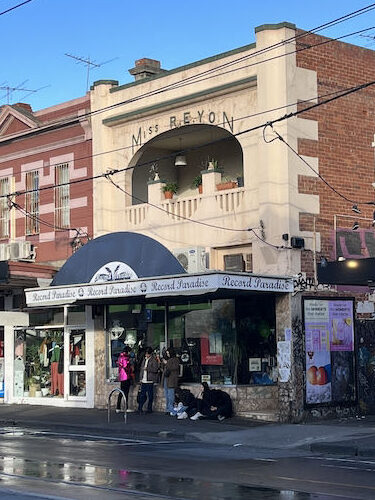
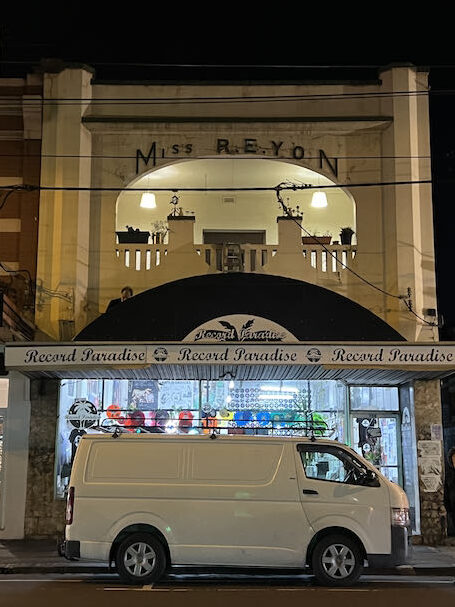
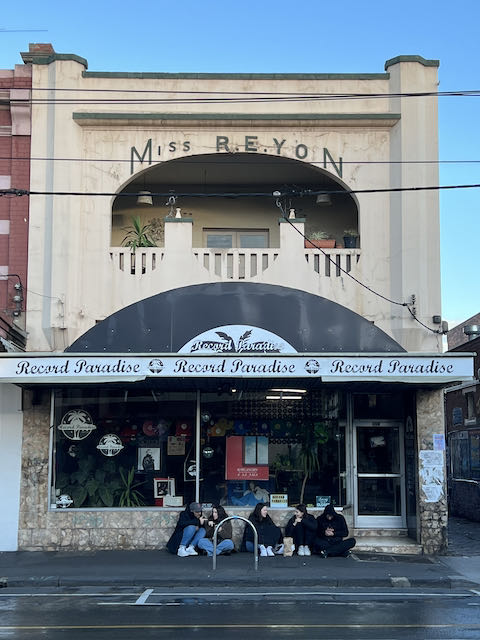
Cream façade, deep arched balcony and MISS R. E. YON lettering above the record shop.

Ruby Ethel Yon had this shop built in 1923. Her trading name still crowns the façade above the first-floor balcony. Dressmaking, clothing sales and family life once shared this narrow Sydney Road address.8

Ruby’s business

Ruby was born in Wangaratta in 1885. Her father, William Yon, was Chinese-born; her mother, Margaret Ah Ket, was born in Victoria. She began as a dressmaker and was established in Brunswick as a costumier by the First World War. The term conveyed a business making and selling fashionable women’s clothing. Her 1914 advertisements supplied a telephone number, still a relatively unusual facility among local businesses.8

In 1915 she married grocer William Hoyling. She continued trading as “Miss R. E. Yon”, keeping the name her customers already knew. Alongside the clothing factory and retail outlet, she raised two children. Having a purpose-built shop gave those activities a permanent home and placed her commercial identity prominently above the street.8

A property dispute in 1923 brought Ruby to court. Her barrister was her uncle William Ah Ket, a pioneering Australian-Chinese lawyer. Ruby died in 1937, aged 51. The lettering has carried her name through the building’s subsequent occupations.8

The arched balcony

The upper façade is arranged around one deep, recessed arch. Its shadow gives the front wall a pronounced sense of depth. The balcony balustrade cuts across the opening, and the room behind it is sheltered by the outer wall. From the oblique angle in the gallery, the thickness of that wall and the projecting side of the building become easier to see.9

Above the arch sits the name panel, incorporated into the parapet: the section of wall rising at the roof edge. The curve draws the eye towards the lettering. Across a small frontage, the architect has concentrated the ornament, the main opening and the proprietor’s name into one compact composition.

The ground-floor sign occupies a separate band beneath the balcony. At street level, the large window presents the shop’s wares to passing pedestrians. Higher up, Ruby’s name remains visible across the road and above the awning. The building carries both scales of advertising in the same elevation.

A shop and a household

Ruby’s documented combination of making, selling and living here gives the upper floor a particular interest. Behind the shopfront was the work of producing clothing; above it was the domestic side of the enterprise. The balcony gives that mixed use a visible expression. Her retained trading name also records the independence of a business identity that continued through marriage and family life.8

Map this stop
02Sydney Road · West side

Phoenix Street corners

2A · Tough’s ironmongery
West side · south corner of Phoenix Street

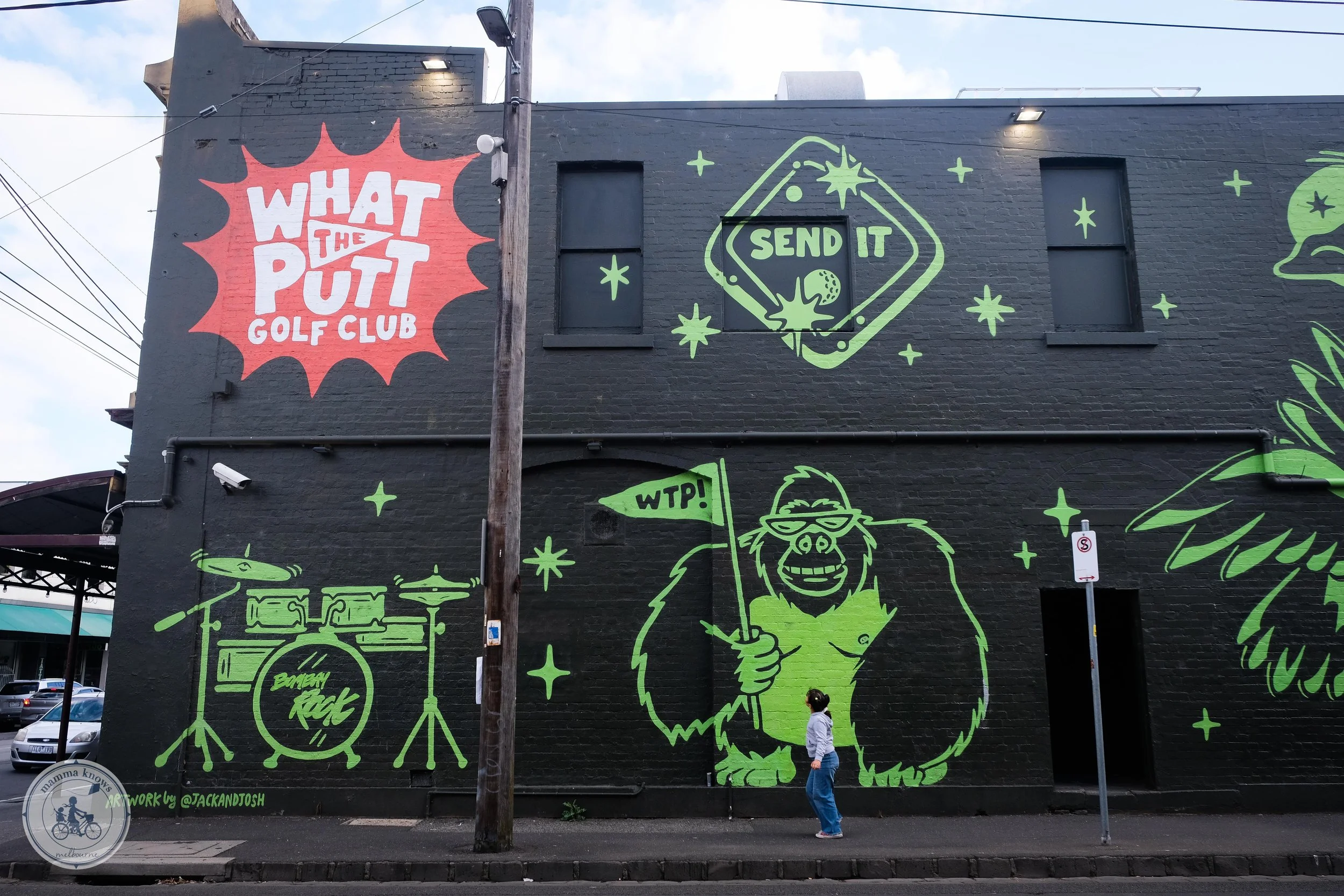
Cream corner building with TOUGH high above the windows. What The Putt enters from the black-painted Phoenix Street side.

Tough’s ironmongery occupied the south corner of Sydney Road and Phoenix Street from 1884 until after the First World War. The family had moved to Brunswick in 1858, following earlier work in Geelong making sails, tents and tarpaulins.7

The Sydney Road frontage

The Tough name sits in the raised centre of the parapet above the first-floor windows. Moulded bands, shallow projecting strips and small roof-edge ornaments give the broad street wall its formal composition. The awning divides the decorated upper storey from the shopfront below.6

The gallery opens with the cream-coloured Sydney Road frontage photographed by 2022. Its second photograph shows the Phoenix Street side in January 2023, painted black with What The Putt murals. The corner and the end of the Sydney Road verandah appear at the left edge of that side view. Round the corner on the footpath to follow the change from the ornamental front to the plainer brick side wall.6 30

The Death in Brunswick still records an earlier red-and-blue paint scheme. The parapet outline and upper windows provide fixed points for comparing the two Sydney Road views.6

Bombay Rock

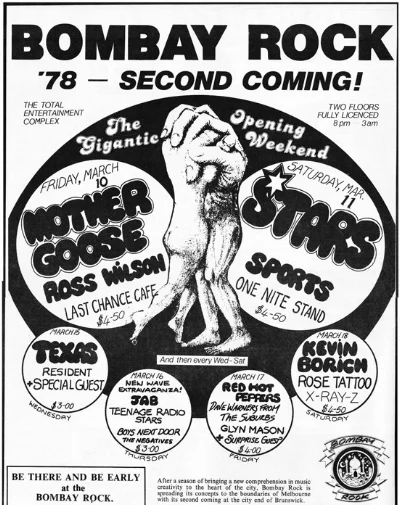
Promoter Joseph Gaultieri took over a Greek nightclub here and relaunched the Brunswick Bombay Rock on 10–11 March 1978. Established acts played in the large upstairs room, while younger bands appeared downstairs. Cold Chisel, Midnight Oil and the Boys Next Door were among the performers.10

Gaultieri described installing a stage, window baffles and curtains to improve the sound. Road crews carried equipment up the back stairs. The opening advertisement’s separate Friday and Saturday bills show how the venue sold a full evening of performances. A performance still attributed to the Sports around 1979 gives a glimpse of the stage and audience.10 6

What The Putt

The Brunswick Community History Group’s 2025 tour places Tough’s, Bombay Rock and What The Putt at this address. What The Putt gives its entrance as Phoenix Street, 305 Sydney Road. Its photograph and walkthrough show the modern entertainment fitout.7 3

3D walkthrough

305: What The Putt walkthrough

The modern venue at 305 Sydney Road, entered from Phoenix Street.

Open Matterport · Official source

Cross Phoenix Street2B · Davison’s grocery · 307–311
2B · Davison’s grocery
West side · north corner of Phoenix Street

Cross Phoenix Street to the building with five arched upper windows and a balustrade along the roof.

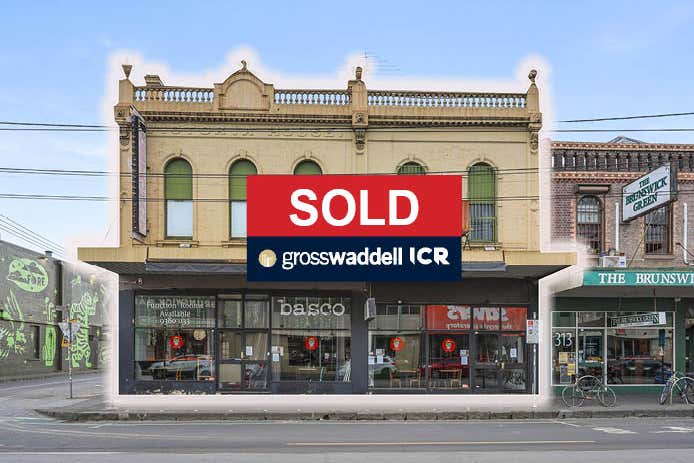
Across Phoenix Street, Robert Davison’s grocery occupied 307–311 Sydney Road. His father William had emigrated from Scotland around 1853. The family remained in Brunswick for generations. The grocery’s historic frontage was crowded with advertisements and displays of everyday provisions.7

The round-headed windows

Five round-headed upper windows line the 2023 frontage photograph. Above them, a balustraded parapet rises to a central ornamental crest. The window arches and repeated balusters give the elevation a regular rhythm. The ground floor carries the later Basco restaurant frontage.5

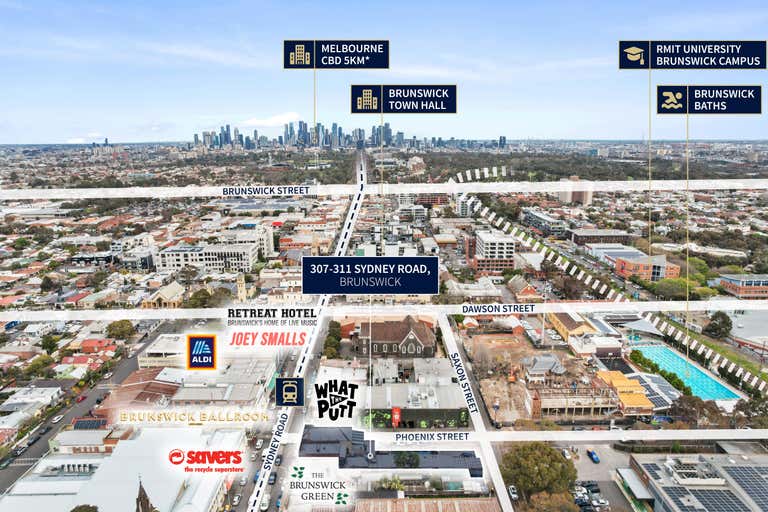
The property’s northern neighbour is the Brunswick Green. Phoenix Street lies along its southern side, visible on the left of the front-on photograph. The aerial image shows the road separating Davison’s from the What The Putt property.5

Groceries to restaurants

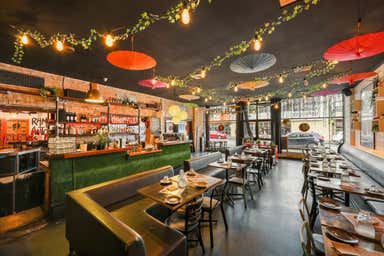
Later occupants included Curly Joe’s restaurant and pizzeria, followed by Basco. The 2023 property photographs and film record a restaurant fitout at 307–311, with timber flooring and a long room extending behind the shopfront. The archive page below includes the earlier grocery façade.7 5 4

Film

307–311: Davison property film

A tour of the former Davison property from the 2023 sales campaign.

Open on Vimeo · Official source

An earlier Davison shopfront in the archive

An earlier photograph of Davison’s grocery frontage.

Iconic Shops, 2025 · Sydney Road Brunswick Association / Brunswick Community History Group · page 8.

Open the booklet at this page

Map Tough’s
03Sydney Road · West side

The variety stores

3A · Former Woolworths403–407Sydney Road ↗

Italiano’s Fresh Produce + Bougatsaki

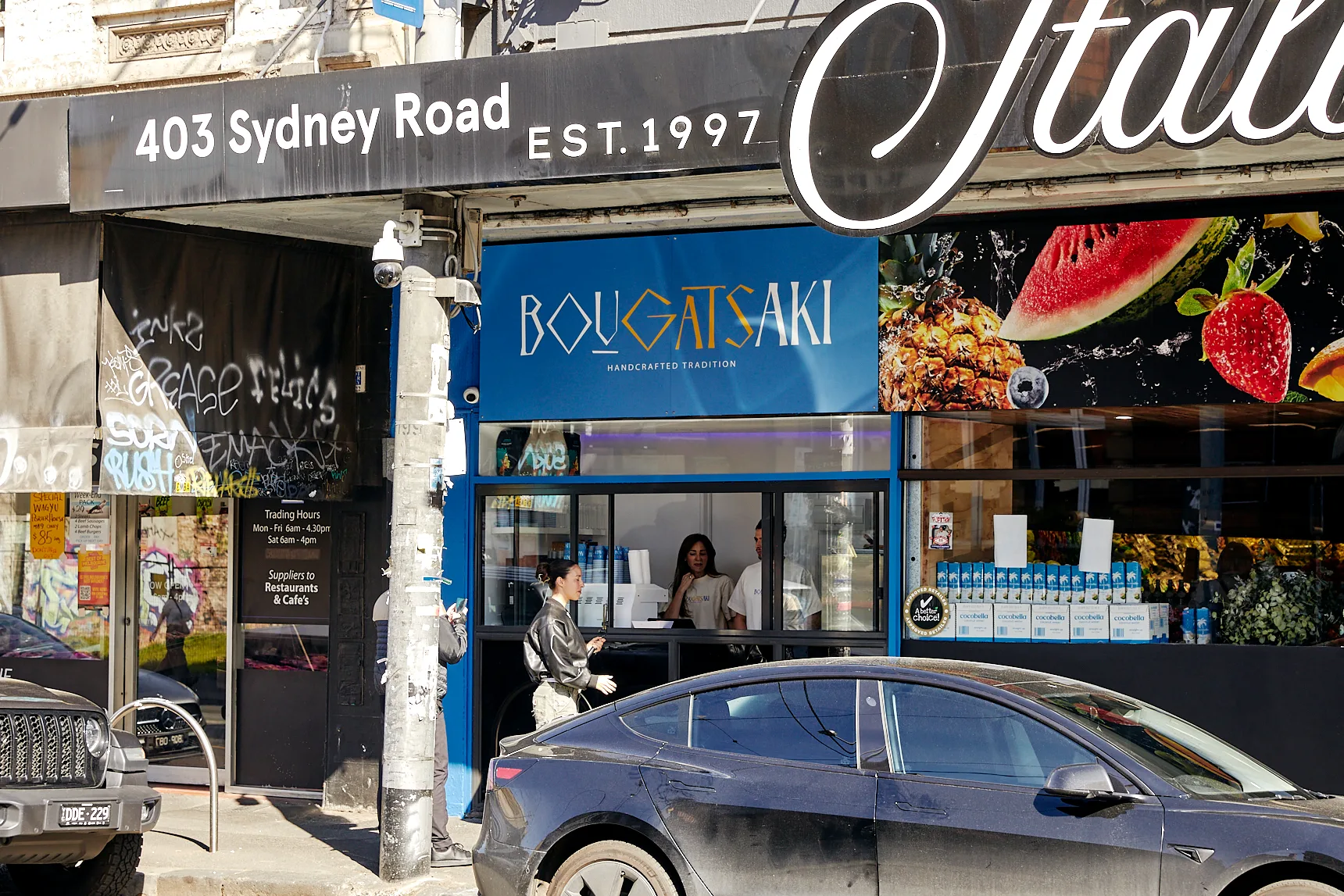
The blue Bougatsaki hatch at 403 Sydney Road, with 403 printed on the black awning and the Italiano’s Fresh Produce sign to its right.September 2026

Look for 403 on the black awning and the small blue serving hatch.

Photo source
↑ Continue north on the same footpath
3B · Former Coles415Sydney Road ↗

Bunnings Brunswick

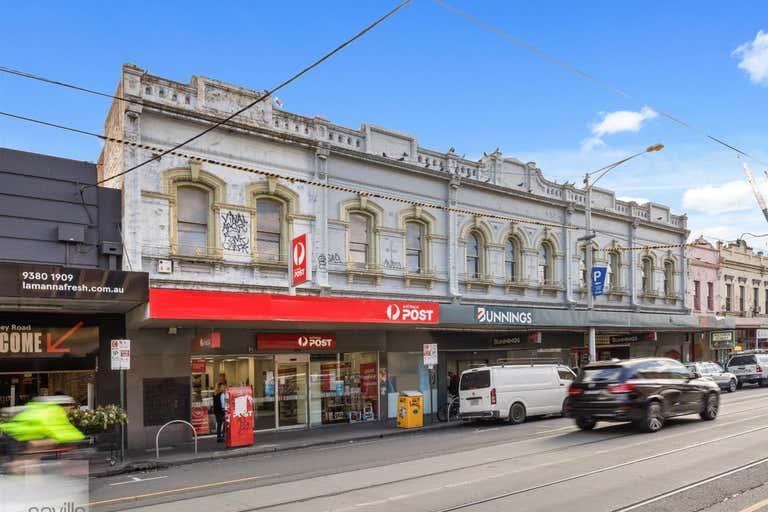
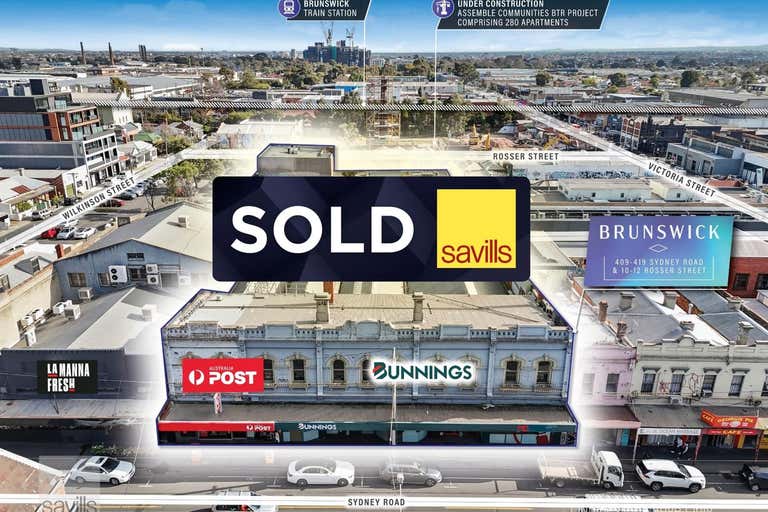
The full pale two-storey commercial façade at 409–419 Sydney Road, with Australia Post on the left and Bunnings at number 415 on the right, beneath decorative upper windows.2025 sale listing

The Bunnings entrance is beneath the long pale façade, beside Australia Post.

Photo source
7 photos Street views, archives & comparisons
See the actual Coles / Woolworths frontage in 1957

The former Coles and Woolworths premises in the local history booklet.

Iconic Shops, 2025 · Sydney Road Brunswick Association / Brunswick Community History Group.

Open the booklet at this page

Woolworths occupied the fruit-shop premises at 403–407. It arrived in 1937, after Passfield’s bakery, and traded until 1980. La Manna Fresh followed. Today, the frontage belongs to Italiano’s Fresh Produce, with Bougatsaki’s blue hatch at number 403.7 34

Coles occupied the premises now signed Bunnings at 415. Its variety store opened in 1923. The building later housed Spotlight before Bunnings. The red Australia Post shopfront in the wide photograph is immediately to the left of the Bunnings entrance.7 35 36

The commercial frontage

A display window turns the pavement into part of the shop’s selling space. Glazing frames the merchandise, the recessed room behind it allows a staged arrangement, and the awning shelters people as they pass or stop to look. The window is both an architectural opening and a small advertising stage.

Along this part of Sydney Road, shopfronts have been altered repeatedly as businesses changed. Upper elevations, awnings, windows and signs can each belong to a different period. The early photographs concentrate on the display itself, giving an unusually close view of the work that once went into attracting a passing customer.

Coles, 1933

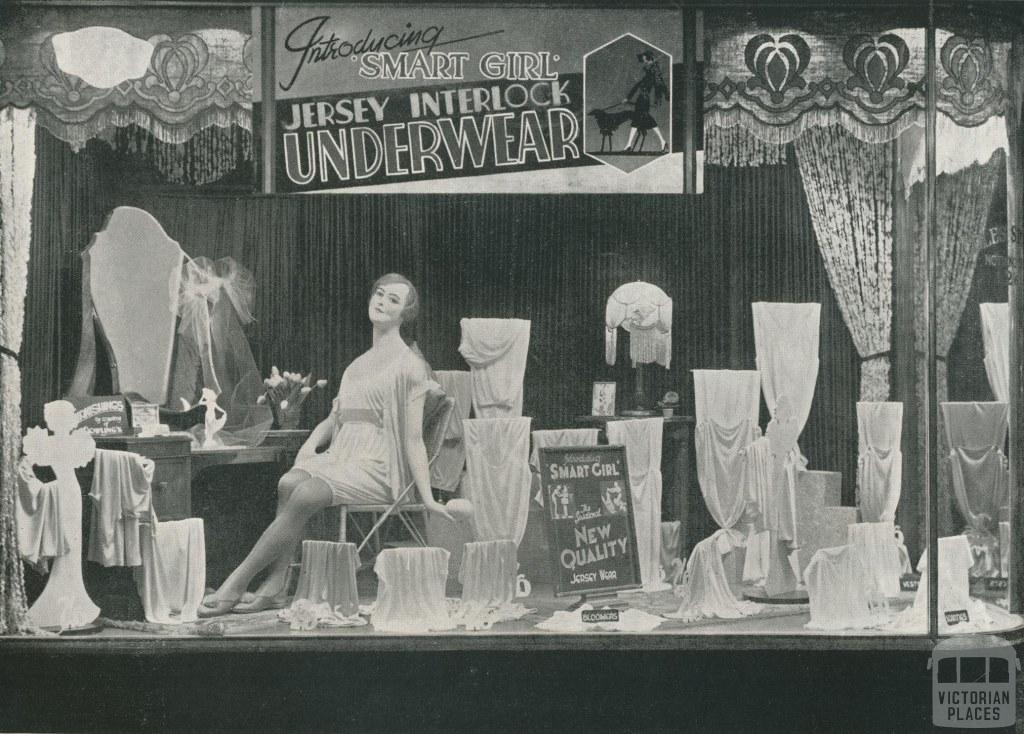
The lingerie display published in the September 1933 Colesanco Staff Journal uses curtains, fabric-covered stands and a seated mannequin to build a miniature room. The eye travels from the figure to the raised merchandise and then to the large brand panel above. Draped fabric softens the rectangular frame of the window.12

The products have been arranged vertically and given different heights, so they remain visible behind one another. The mannequin supplies a human scale. Curtains at the sides provide a theatrical frame, turning an ordinary sales display into a scene that can be understood from the footpath.

The wool display, 1934

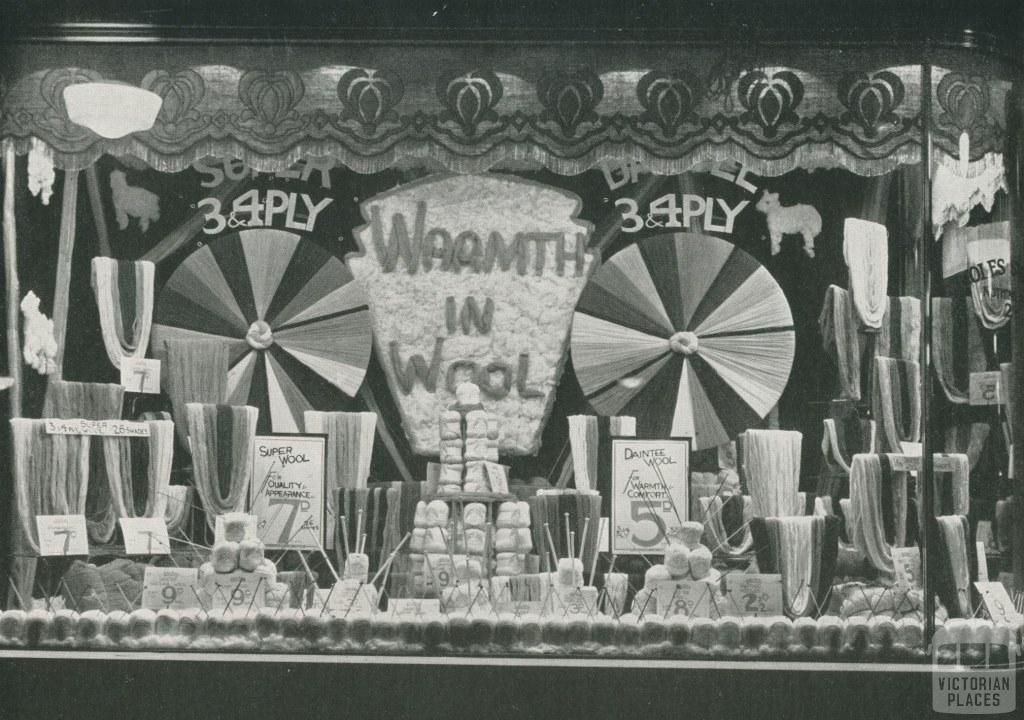
The following year’s photograph uses the merchandise to make the pattern. Wool radiates in fans across the window, interrupted by individually written price cards. The repeated lines make the display legible at a distance; the cards reward a closer look. It was published as a window-dressing competition entry in June 1934, evidence of the skill and staff pride invested in this work.11

Compare the two windows side by side in the gallery. The 1933 arrangement gives the goods a domestic setting. The 1934 arrangement makes a spectacle of quantity, colour and price. Both rely on the window’s depth and frame to hold a complicated composition together.

Dryen’s at 365 Sydney Road

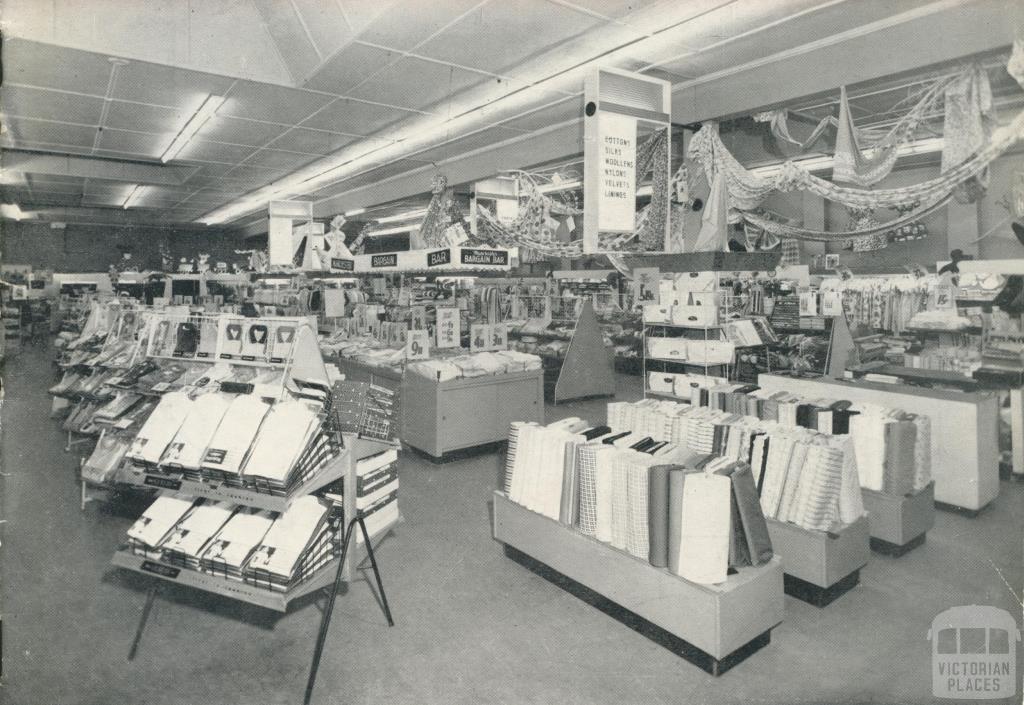
The 1960 interior photograph records Dryen’s at 365 Sydney Road. Its refurbishment introduced fluorescent lighting, open circulation, repeated low counters and textiles displayed above the sales floor. The long ceiling lines and counters draw the eye into the building.13

The photograph shows how much a shopping interior could change within an existing commercial shell. Lighting, ceiling finishes, counters and circulation were all part of modernising the business. That 1960 fitout now provides its own period record of retail design.

Map this stop
04Sydney Road · Brunswick

Franco Cozzo

East side · corner of Victoria Street

White corner building, pointed upper windows and red FRANCO COZZO lettering.

The pointed windows at 466 Sydney Road belong to a commercial complex built around 1892. It began as six neo-Gothic premises, including a Bank of New South Wales branch that remained until 1896. Maples traded here from 1913, before the address became associated with Franco Cozzo’s furniture business.7

The Gothic façade

Neo-Gothic design borrowed from medieval architecture, particularly its pointed arches. Here those arches form a repeated pattern across the upper storey. Each apex draws the eye upwards, while the straight sections of wall between the windows divide the frontage into individual bays. The recurring openings hold the larger commercial group together visually.

The 2012 photograph shows the relationship clearly: a sequence of pointed upper windows sits above a long, flat band of shopfront glazing and lettering. The corner gives the façade a second direction, allowing its architectural pattern and the furniture-store name to address both approaches.14

The complex has also been altered. An end section lost its upper storey in 1980, and the original street-level fronts and verandahs were replaced. The surviving upper openings therefore provide the strongest link with the nineteenth-century composition.7

Franco Cozzo on television

Franco Cozzo became familiar far beyond the people who bought his furniture. His television advertisements moved between Italian, Greek and English, with Cozzo himself doing the selling. The ABC’s account places that multilingual performance in a television culture where migrant accents had much less prominence.16

The advertisement in this guide supplies the voice associated with the building’s name. Cozzo’s gestures, delivery and changes of language make the showroom a destination with a recognisable personality. The business name became attached to both a particular style of furniture and a particular way of presenting Melbourne’s migrant commercial life.

Film

Franco Cozzo’s television advertisement

The multilingual commercial reproduced in Brunswick Voice’s reopening report.

Open on YouTube · Publisher / context

The showroom’s return

The Brunswick store closed in 2021. Following Cozzo’s death in December 2023, his daughters Diana, Lisa, Angelina and Alessia worked towards reopening it. Customers returned on 19 September 2026. Brunswick Voice’s report describes repairs, a new interior mural by Heesco, and displays of family photographs and newspaper clippings.15

The reopening photographs bring the view down to the entrance and into the showroom. The crowd gives a sense of the shopfront’s scale at pavement level. Inside, the mural adds a new record of the family business to the older commercial building. The 2012 exterior and the 2026 views can be placed beside one another in the gallery.

Palazzo di Cozzo

Madeleine Martiniello’s 2021 documentary follows Cozzo’s world of family, migration and furniture. Its official trailer broadens the view beyond the Brunswick façade, showing the person whose commercial identity became attached to it.1718

Film

Palazzo di Cozzo: official trailer

Madeleine Martiniello’s 2021 documentary about migration, family and furniture.

Open on YouTube · Publisher / context

Map this stop
05Sydney Road · Brunswick

Hooper’s / Hardwick Building

West side · beside Sparta Place

The long red-brick façade with round arches and pale decorative columns.

H. W. and F. B. Tompkins designed this building for John H. Hooper’s drapery business in 1908. Its long red-brick frontage gave the store a substantial presence on Sydney Road. The gallery follows the same arched façade through three periods: Hooper’s trading years around 1920, the building for sale in 2000, and its later life as the Hardwick Building.20

Hooper’s, around 1920

The early postcard shows the store beside a tram and pedestrians, with large retail lettering extending across the frontage. A verandah defines the sheltered pavement beneath it. At the corner, the façade turns smoothly into the long sequence of arches receding along the street.21

The building addresses customers at several distances. Close to the pavement, entrances and windows divide the frontage into manageable sections. Farther away, the continuous name and repeated upper windows make the whole store recognisable. The architectural rhythm remains easy to identify across photographs taken a century apart.

In the postcard, follow a single arch and then the brick pier beside it. Repeat that movement along the elevation. This is the basic unit, or bay, from which the longer composition is assembled. The scale of the store comes from the number of times that unit is repeated.

The building in 2000

John Young’s photograph records a period of decline. A large sale board, assorted shop advertising and a worn awning compete for attention below the orderly upper façade. Breathe’s project history also describes an unsuccessful indoor technology market called Computer City during the building’s later retail life.2220

The picture is particularly useful for separating the building’s main architectural form from its changing commercial presentation. The brick piers, arches and decorative upper edge still read as a coherent whole. The messages and entrances beneath them had become fragmented. In the gallery’s comparison mode, align your attention with the same arch in each photograph.

Brickwork, arches and capitals

The 2025 photograph shows the contrast between red brick and pale ornamental details. At each arch’s springing point, where the curve begins, lighter decorative capitals emphasise the division between the supporting pier and the opening above. Their repetition gives the long façade a pronounced rhythm.23

The parapet finishes the roof edge with small vertical accents. These details keep the upper outline from becoming a flat strip. They also give the eye a second, finer pattern above the much larger window arches. Across the street, the light-coloured elements remain readable against the brick.

Ruby Yon’s shop concentrated a proprietor’s name and a deep arch into a single narrow frontage. Hooper’s extends its identity through repetition. The two buildings show how related elements can serve very different commercial scales.

The Hardwick adaptation

In the mid-2000s, Mariana Hardwick’s bridal business became the basis for a substantial adaptation. Breathe used the structural grid to divide the perimeter into 17 smaller tenancies. The bridal emporium occupied the centre, with dressmaking workshops on the first floor.20

The project included new timber shopfronts, shading awnings and work around Sparta Place and Tripovich Street. A building associated with a large retailer could now accommodate a collection of smaller businesses while retaining its overall presence on Sydney Road.

The side spaces give a closer view of that adaptation. The monumental street elevation continues to identify the whole building, while individual entrances and windows provide the smaller units with their own public edges. Manufacturing, specialist retail and the surrounding pedestrian spaces all became part of the next phase of use.

Film

Elisabeth Jackson on the Hardwick Building

A local-history film from Sydney Road Brunswick Association.

Open on Facebook · Publisher / context

Map this stop
06Sydney Road · Brunswick

Mediterranean Wholesalers

East side · right as you walk north

One long shop sign beneath several different upper façades.

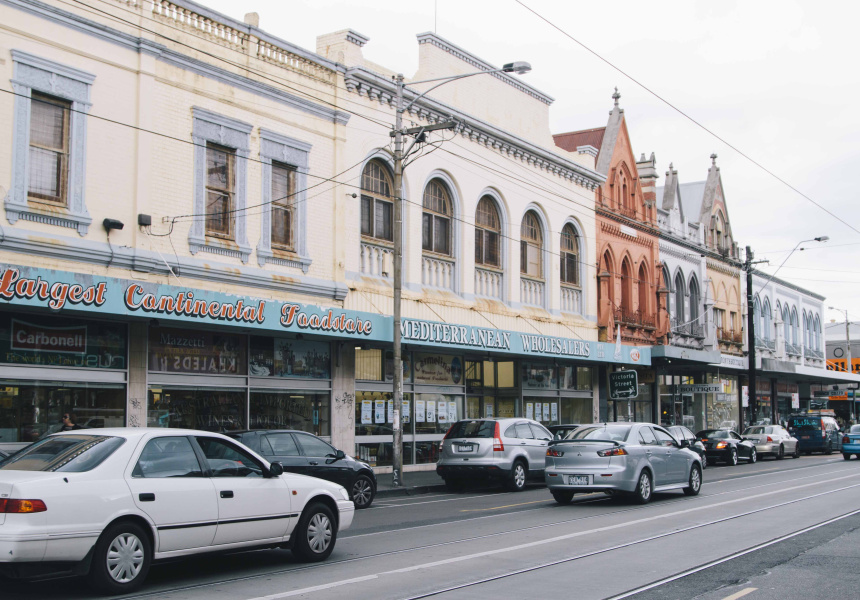
Giuseppe and Carmela Madafferi opened a small Sydney Road delicatessen in 1961. Mediterranean Wholesalers grew from that shop into a food store and importing business occupying several adjoining frontages. The continuous sign unites buildings with noticeably different upper windows and rooflines.25

From delicatessen to wholesaler

In a 2023 interview, their son Andrew recalled Giuseppe arriving from Calabria as a child, working in the Shepparton district and later moving into Melbourne retail. He placed the acquisition of the present premises in 1977, during the family business’s expansion.26

Around 1980, according to Andrew’s account, the business faced increasingly difficult supply arrangements as supermarket chains expanded. Giuseppe travelled to Italy to find alternative brands directly. Importing gave the family greater control over product selection, but it also required customers to trust brands they might never have encountered.26

That trust was built through the daily work of the shop. Coffee tastings introduced different blends and developed into the in-store coffee bar. Carmela worked alongside suppliers in Italy, maintaining a practical connection with the products being imported. Procurement, credit, selection and customer relationships all contributed to the store’s growth.26

Several buildings under one sign

The exterior photograph is easiest to read in two horizontal bands. Along the pavement, a continuous awning and business name draw the premises together. Above them, changes in window shape, spacing and parapet detail reveal several architectural sections.27

Trace a vertical line where one arrangement of windows gives way to the next. Then follow the roof edge across the same point. These changes show how the store’s public identity stretches across older divisions in the streetscape. The upper façades retain the character of individual buildings while the sign below presents one destination.

There is a useful comparison with the Hardwick Building nearby. Hooper’s large, unified premises were divided into smaller tenancies. Mediterranean Wholesalers brought several frontages together under one business. Both adapted existing commercial buildings to a changing scale of trade.

Inside the store

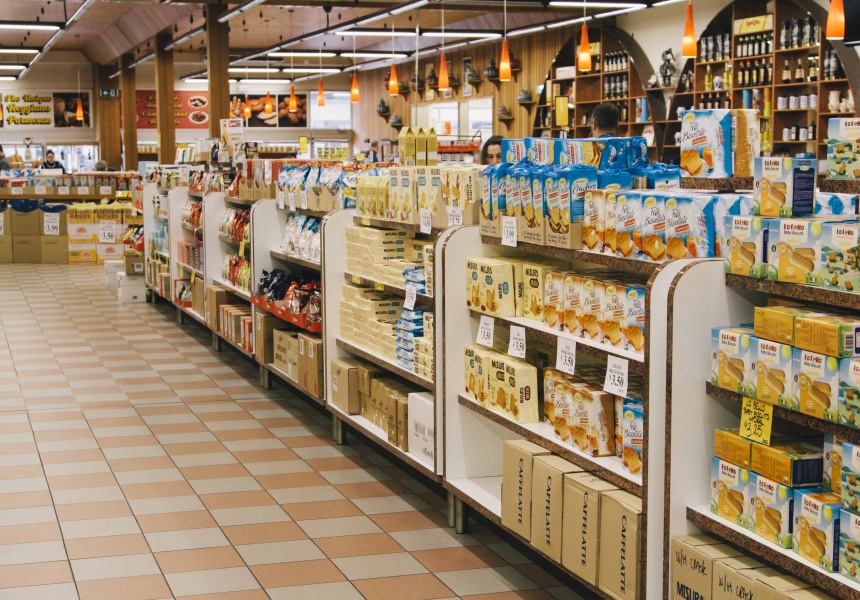
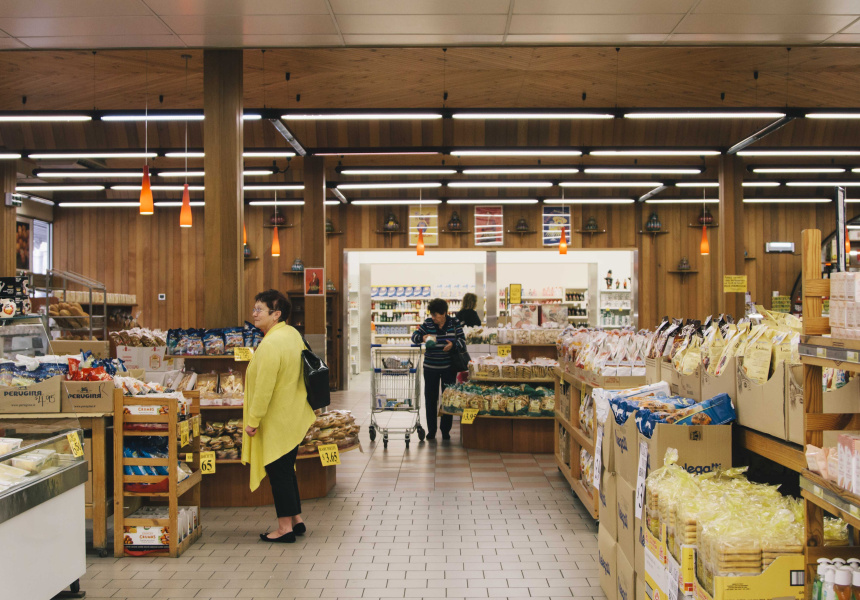
The gallery’s interior views reveal long counters, shelving, columns and ceiling lines. Follow those lines towards the back of the room to understand the depth behind the street frontage. The photographs give a much fuller sense of the occupied building than the exterior alone.27

The 2023 counter photograph brings the scale down again, to the space where staff and customers meet. The coffee bar grew from the practical task of introducing new products, and became part of the way people used the store. Alongside the retail shelves and imported goods, that repeated contact helped make the business a neighbourhood destination.26

Mediterranean Wholesalers’ own account describes the deli, coffee bar and specialist pantry goods as central parts of the operation. An interior visit adds those everyday uses to the architectural view from the road. The business closes on public holidays.25

Map this stop
07Sydney Road · Brunswick

Parker sisters’ confectionery

West side · just south of Hope Street

Large faded CHOCOLATE lettering above a cream awning, beneath a curved roofline.

Amy and Rene Parker opened their confectionery here shortly before 1925, in a newly built shop. Amy was in her forties and Rene in her thirties. The faded chocolate advertisements above the awning preserve a visible record of their line of trade.28

The Parker sisters’ shop

Local research by Sean Reynolds gives several glimpses of the business. In 1935, a confectioner visiting from Westgarth stopped to speak with one of the sisters. During the conversation, his pony and confectionery-laden wagon were stolen. It is a small incident that brings the deliveries and working relationships of the street into view.28

The shop’s 1940 sale description provides a more detailed picture of the interior. Refrigeration, electric mixing equipment and an ice-cream maker supported food production. Display counters, mirrored shelving and a leadlight partition shaped the retail room. Making, storing and displaying confectionery were all accommodated within the premises.28

Mirrors and leadlight would have given the customer-facing space a decorative finish, while the machinery supported the work behind the counter. The large painted messages outside extended that selling effort above the level of the shop window.

The overlapping advertisements

Reynolds identifies an “Ask for Nestlé’s Chocolate” message painted over an earlier “Nestlé’s Milk Chocolate” sign. Violet Crumble lettering survives higher up. The wall was reused for successive campaigns, leaving fragments of several advertisements visible together.28

The clearest large letters provide a starting point. Follow their baseline across the wall, then look for strokes that fall above or below it. Different letter heights and styles help separate the layers. Some strokes continue through another word, exposing the earlier message beneath.

A surviving painted advertisement is commonly called a ghost sign. Here the overlapping layers are part of its appeal. They record changes in the message while the same wall continued to serve as an advertising surface. Weathering has made the sequence partially visible again.

The parapet as signboard

The curved central parapet gives the upper façade a distinctive outline. Its broad wall surface offers room for lettering above the awning, where the message could be read across the road. At pavement level, the window and counters would have presented the confectionery at close range.

In the gallery, enlarge the upper part of the photograph to examine the changes in lettering, then return to the full façade. The shape of the parapet, the position of the advertising and the shopfront below form a compact example of architecture arranged around selling.

Map this stop
08Sydney Road · Brunswick

The red-brick shopfront parade

West side · north of Hope Street

A row of red-brick upper floors with pale triangular window tops and one much larger arch.

The walk finishes at the red-brick shopfront group at 575–585 Sydney Road. Its upper windows form a regular sequence, punctuated by pale triangular heads. A larger arch at one end interrupts the pattern and gives the row a distinctive finish.29

The repeated window heads

The triangular crowning shapes borrow the classical form of a pediment. Set against the red brick, they emphasise each opening and establish a rhythm along the upper floor. The same pattern remains readable above the different shop signs at pavement level.29

Look first along the row, following the window heads from one end to the other. Then follow an individual window down towards the shop beneath it. Some business signs occupy a single unit; others reach across a wider part of the frontage. The building’s architectural divisions and its retail divisions can be read together.

The larger arched opening at the right of the photograph changes the scale of the composition. It provides a point of contrast with the repeated smaller windows and recalls the different uses of arches encountered earlier on the walk.

Above the shops

The gallery includes a modernised first-floor dwelling at 579, photographed for a property listing. A kitchen, stair and high ceiling show the domestic accommodation behind part of the commercial frontage. The photograph adds an interior view of the row; the dwelling itself is private.2

The view south from Hope Street, uploaded in 2004, sets these final stops within the wider shopping street. Shop signs, upper façades, tram infrastructure and the long street perspective combine into the setting through which the walk has passed.1

Map this stop
Back to the start ↑
Sources & credits

01Sydney Road looking south from Hope StreetRobert Merkel / Wikimedia Commons, public domain. Uploaded 11/07/2004. Sydney Road looking south from Hope Street.

02579 Sydney Road: publicly marketed upstairs interiorNicole Gervasi Property Group. Modernised first-floor dwelling at 579. Photograph upload: March 2023.

03305 Sydney Road: official modern-interior photograph and 3D tourWhat The Putt. Official address: Phoenix Street entrance, 305 Sydney Road. Modern venue photograph and Matterport walkthrough.

04307–311 Sydney Road: agent’s property filmGross Waddell ICR. Property listing and Vimeo film 871252189.

05307–311 Sydney Road: 2023 photographic sale recordGross Waddell ICR / realcommercial.com.au. Frontage, aerial and interior views from the 2023 sale campaign.

06Bombay Rock: exterior views and a performance stillNo Nights Off / Thorogood 5050 Tour, November 2022. Dates and film-still identifications follow this collecting blog; original image creators are not all identified.

07Iconic Shops, 2025Sydney Road Brunswick Association and Brunswick Community History Group, 2025. Addresses, building history and former occupants.

08Ruby Ethel Yon: Women of Merri-bekMerri-bek City Council; historical research by Cheryl Griffin. The biographical basis for Stop 1.

09Record ParadiseRecord Paradise. Façade photographs published in April 2024.

10Bombay Rock: the story of a Melbourne rock landmarkIan McFarlane, Third Stone Press / Rhythms, 2018. Includes interviews with Joseph Gaultieri and Sean Kelly, and reproductions of original gig advertisements.

11Brunswick Coles window display, 1934Victorian Places; Colesanco Staff Journal, June 1934; John Young Collection.

12Brunswick Coles lingerie window, 1933Victorian Places; Colesanco Staff Journal, September 1933; John Young Collection.

13Dryen’s remodelled interior, 1960Victorian Places; Retail Merchandiser / Retail Traders Association of Victoria; John Young Collection. Dryen’s at 365 Sydney Road, 1960.

14Franco Cozzo building, 2012Mattinbgn, 21/10/2012. Wikimedia Commons, CC BY 3.0. Photograph displayed uncropped.

15Daughters continue Franco Cozzo’s legacyMark Phillips, Brunswick Voice, 21/09/2026. Reports the 19/09/2026 reopening and includes the original-advert video used in this guide.

16Franco Cozzo retail revivalAlex Sinnott, ABC News, 20/09/2026. Independent corroboration of the reopened Brunswick showroom and context for the television advertising.

17Palazzo di Cozzo: production recordFilm Camp. Documentary directed by Madeleine Martiniello, produced by Philippa Campey and Samantha Dinning.

18Palazzo di Cozzo: official distributorMadman. Official trailer and viewing options.

19Palazzo di Cozzo: official trailerOfficial documentary trailer on YouTube.

20Hardwick Building: adaptive-reuse projectBreathe. Original architects, construction year, later retail decline and the practice’s 2005 refurbishment project.

21Sydney Road postcard, circa 1920Victorian Places; Real Photo Series M1733; Centre for the Government of Queensland collection, University of Queensland. Catalogue date: c.1920.

22Hooper’s building, 2000John Young / Victorian Places. Records the building before the Hardwick adaptation.

23Hardwick Building, September 2025Nick-D, 17/09/2025. Wikimedia Commons, CC BY-SA 4.0. Photograph displayed uncropped.

24Elisabeth Jackson: a Hardwick Building history storySydney Road Brunswick Association. Elisabeth Jackson on the Hardwick Building.

25Mediterranean Wholesalers: official history and hoursMediterranean Wholesalers. Business history, address and trading hours.

26The secret of Mediterranean Wholesalers’ successKevin Murray, Brunswick Voice, 23/01/2023. Interview with Andrew Madafferi; the importing story is presented as the family’s recollection.

27Mediterranean Wholesalers: reference photographLinsey Rendell / Broadsheet. Source page updated 13/03/2018; exact photograph date not stated.

28Chocolate and Violet Crumble: 543 Sydney RoadBrunswick Residents Network, February 2023; research by Sean Reynolds / Melbourne Ghost Signs. Includes the Parker sisters, a 1935 incident and a 1940 sale description.

29Shopfront group at 575–585 Sydney RoadPhilip Mallis, 18/01/2021. Wikimedia Commons, CC BY-SA 2.0. Shopfront group at 575–585 Sydney Road.

Research notes

Photo dates are labelled by capture, publication or upload. The Bombay Rock film and performance stills follow the collecting blog’s attributions. Building commentary is based on the cited records and photographs; the architect and construction date of the final parade remain unconfirmed.

Sources differ on the year of the Hardwick acquisition, so the text uses “mid-2000s”. The original broadcast date of the Franco Cozzo advertisement is unconfirmed. Historical trading dates are retained from the September 2026 edition.

Images retain their source credits and linked licences. Photographs and players load online; external source links accompany each item. The route diagram tracks reading position. Theme and visited stops are saved in this browser.

30What The Putt: Phoenix Street exterior, January 2023Mamma Knows North, 20/01/2023. Side-elevation photograph of the venue at 305 Sydney Road.

34403: Italiano’s and Bougatsaki, September 2026Broadsheet, 19/09/2026. Casey Horsfield photography; confirms the new business names at 403.

35Bunnings and Australia Post: full frontageSavills sale listing, sold 24/02/2025. Full exterior at 409–419 and annotated aerial photograph; exact capture dates unstated.

36Bunnings Brunswick: official address415 Sydney Road. Address checked 26/09/2026.

37Former La Manna Fresh frontageEarlier full-building photograph, date unstated. Superseded shop branding is identified in the caption.

38Evie & John’s: official address543 Sydney Road. Address checked 26/09/2026.

39Azeemah: current premisesOfficial profile gives 307–311 Sydney Road. Address corroborated by the charity register and First Table.

Exterior photographs are dated individually. Modern reference views range from 2018 to 2026; some capture dates are unstated. Business names and addresses added in this edition were checked on 26/09/2026. Photographs and films load from their credited publishers.
Photograph

100%

Zoom, then drag to inspect. Arrow keys change images; Esc closes. On touch screens, pinch to zoom.